Can a tanto collab with artists create fresh buzz around your catalog?
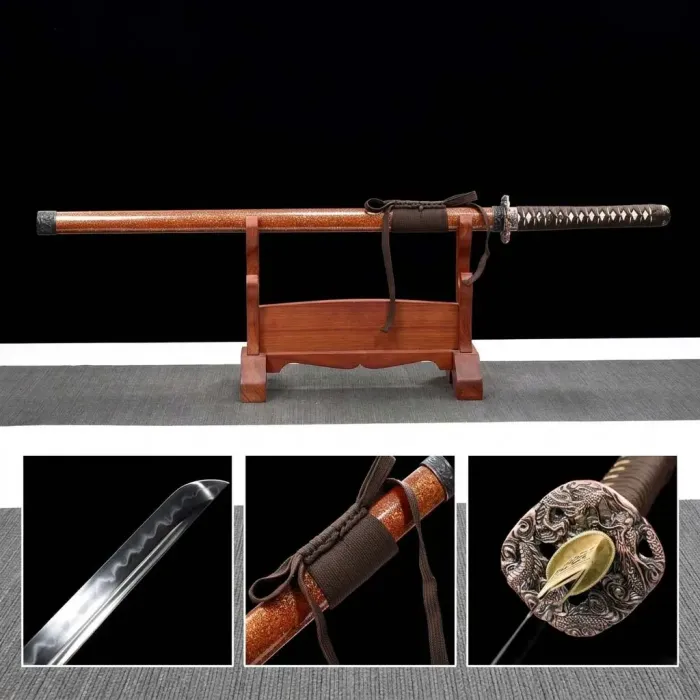
A classic Japanese sword exists as a exquisite piece of craftsmanship, but say you want to convey your individual character? Customizing your armament is a fulfilling journey, allowing you to design a truly uncommon piece. From the grip wrapping and fastening to the tsuba design and cutting motif, each segment offers a chance for distinctive style. This review delves into the space of katana revisions, providing insights for both novices and accomplished enthusiasts seeking to set their trace on the ancient art of the samurai.
Novice's Certified Craftsmanship
For people ready to embark on the advantageous journey of classical sword techniques , 1060 steel katanas extend an excellent entry point. This particular grade of elemental-based steel finds a suitable blend between price and efficiency . While below hard as leading steels, 1060 allows for a reasonable level of honing , making it ideal for starters to cultivate the preliminaries of blade care and enjoy the grace of genuine Japanese weaponry. It’s a superb choice for establishing experience without the fiscal burden of more enhanced steels.
T10 Steel Katanas : Balancing Performance and Affordability
For enthusiasts seeking an authentic katana experience without breaking the bank , T10 steel katanas represent a advantageous option. These implements offer a clear improvement in sturdiness compared to basic alternatives, exhibiting respectable edge retention and enough flexibility for fundamental chopping techniques. While not rivaling the exceptional characteristics of higher-grade steels like T100 or folded element , T10 provides a commendable blend of efficiency and economy , making them a widespread choice for newcomers and those on a limited resources .
Exceeding the Sword : Personalizing Your Tool's Accessories and Hilt
Even though the polished metallic edge is undeniably the core point of a katana, truly refining its magnificence lies in the precise customization of its components and tsuka . This approach allows users to showcase their special flair . Consider the ample possibilities: menuki - decorative charms that introduce visual appeal ; the hamon sheaths – often masterfully etched ; the tsuka nucleus itself, wrapped in classic ito rope ; and the fusa butt cap , which can be fabricated from various elements like treasures or ivory .
- Prefer concepts that resonate with you.
- Explore with different ingredients .
- Prioritize excellence for a durable effect .
The Charm of the Katana: Heritage, Workmanship, and Metal
Such katana retains a incomparable allure, steeped in ages of oriental history and practice . More than merely a tool of fighting , it's a sign of the warrior ethos – a fusion of expertise and command . Its unfolding spanned numerous generations, with early cutting instruments evolving into the sleek-lined curvature and deadly edge we know today. The workmanship involved is truly impressive , requiring years of study to excel at . The process involves a elaborate folding of metal bloom, creating layers that enhance the cutting edge’s flexibility and carving ability. Numerous schools of smithing developed , each with their individual secrets and approaches for achieving the supreme proportion and crispness - a truly laborious pursuit.
- Initial Katana models
- The significance of the oriental sword in fighter class culture
- Time-honored fabricating procedures
Determining the Right Steel for Your Weapon Project: 1060 vs. T10
Choosing the correct steel is absolutely important for any katana project, and the decision between 1060 and T10 can be tricky. 1060 is a popular American element, offering a competent balance of rigidity and persistence, supplying it comparatively easy to forge. However, T10, a Oriental steel, ordinarily boasts increased wear durability and can conceivably achieve a more peak hardness, although it can be somewhat difficult to apply and requires detailed heat forging. Consider your competency and projected results: for a beginner, 1060 may be a prudent platform, while the veteran smith might seek the extra merits of T10.
- User-friendliness of Controlling
- Corrosion
- Peak Hardness
Unleashing the Power: High-Level Katana Modification Methods
Excelling in the craft of sword improvement extends far beyond basic finishing. Serious practitioners are now analyzing advanced techniques to truly discover a blade's hidden potential. This entails intricate work with the heat signature, utilizing specialized ingredients for differential tempering and carefully opting for the form of the tsuba to optimize balance and quality. Beyond purely functional modifications, artisans are increasingly focused on realizing unparalleled aesthetic charm, through complex etching and layered films that truly transform a katana into a creation.
From Elemental Metal to Artistry: Forging a 1060 Blade
The journey launches with standard 1060 fabrication , a resilient material far lacking the beautiful katana it will mature into . Master bladesmiths execute a involved process of stacking and shaping the initial steel, repeatedly heating it and striking it to purify impurities and form a katana symmetrical grain structure. This laborious process, often persisting for cycles, builds the essential hardness and flexibility characteristic of a real Japanese edge . Further heat procedures , including methodical hardening and tempering , are essential to achieve the targeted balance of sharpness, life and charm .- Uniting: Removes impurities and develops grain structure.
- Forming: Fabricates the steel into the initial blade form.
- Tempering: Decides the final hardness and flexibility.
The Enduring Appeal of the Katana: A Deep Dive into Steel and Customization
An venerable katana holds present a intense symbol of Japanese heritage , its fascination far exceeding mere armaments . Forged from rare steel and habitually featuring intricate trims, the process of creation itself is a revered art. Beyond the basic craftsmanship, the ability to modify a katana - from the blade pattern to the grip wrapping and clasp - opens for a perfectly individual communication for both supporters and operators alike. This amalgamation of tradition-rooted steelwork and boundless personalization brings the katana's continued presence across the realm .